成果简介
现代高速飞机需要兼具电磁波吸收能力、轻质特性、柔韧性及抗极端热流性能的材料。尽管石墨烯@二氧化硅织物(G@SF)在此领域展现出广阔前景,但其均匀的片电阻分布导致界面波阻抗失配,从而限制了电磁波耗散能力。本文,北京石墨烯研究院/北京大学Guang Cui、刘忠范 教授、北京工业大学王慧慧、哈尔滨工程大学Maoyuan Li等研究人员在《ADVANCED MATERIALS》期刊发表名为“Flexible Graphene@Silica Fabric Metasurface for Electromagnetic Wave Absorption on High-Speed Aircraft”的论文,研究采用减法激光“擦除”技术处理经化学气相沉积法生长的G@SF,开发出可扩展、柔性、超薄(0.1毫米)且耐高温(高达1000℃)的超表面,其阻抗可调以实现航空航天电磁波吸收。该超表面直接集成于飞机隔热层,形成集成式吸收体,在不增加显著重量或改变飞机结构的前提下,将雷达反射降低至-42 dB。全无机设计确保其在高温、高速气流冲刷及机械应力下具备卓越耐久性,成为航空航天应用的理想选择。该方法为制造兼具性能、韧性和可制造性的新一代电磁波吸收材料提供了极具前景的途径。
图文导读
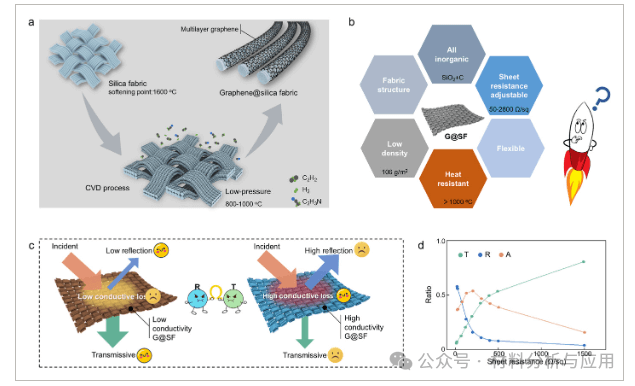

图1、Advantages and limitations of G@SF as an EMW absorber in aerospace systems. a) Schematic of G@SF fabrication. b) Advantages of G@SF as an EMW absorber in aerospace systems. c) Trade-off between conductive loss and reflection with respect to the conductivity of G@SF. e) Variation in the absorbance, reflectance, and transmittance with the sheet resistance of G@SF.
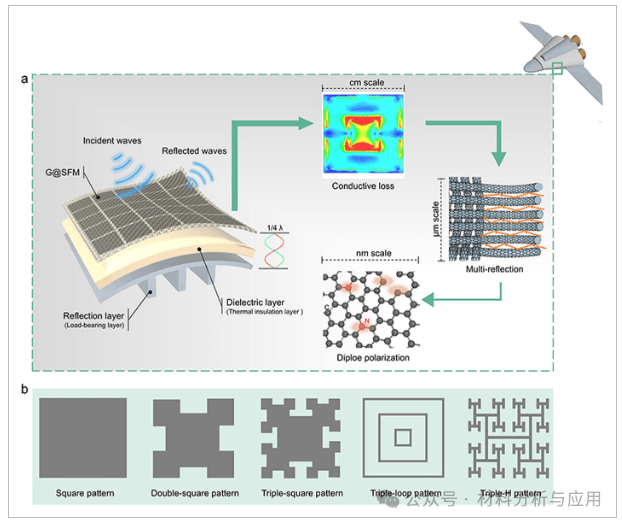
图2、Structure design and Computer Simulation Technology (CST) simulation results for the G@SFM absorber. a) Absorption mechanisms and structural design of the G@SFM absorber. b) Patterned G@SFM unit cells used in the simulations.
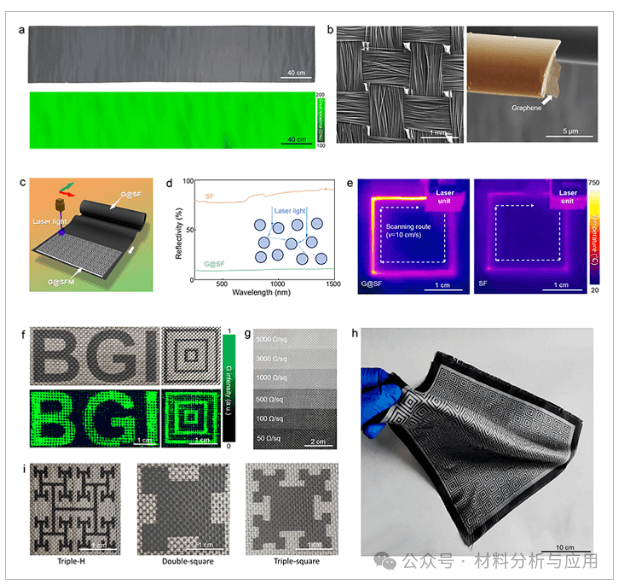
图3、Fabrication of G@SF and G@SFM. a) Image and sheet resistance distribution of large-sized G@SF. b) SEM images of the fabric structure of G@SF (left) and the graphene layer on silica fiber substrate (right). c) Schematic of the laser direct “erasing” process. d) Reflectivity of SF and G@SF at different wavelengths. e) Infrared images of G@SF and SF obtained during laser direct “erasing” (2 W, 10 cm s−1). f) Patterns on G@SF and the corresponding Raman mapping images (green). g) Gradient grayscale graph of patterned G@SF (50 Ω sq−1). h) Digital photograph of the as-fabricated flexible G@SFM. i) Digital photographs of different metasurface unit cells. Left to right: triple-H pattern (TH-pattern), double-square pattern (DS-pattern), and triple-square pattern (TS-pattern).
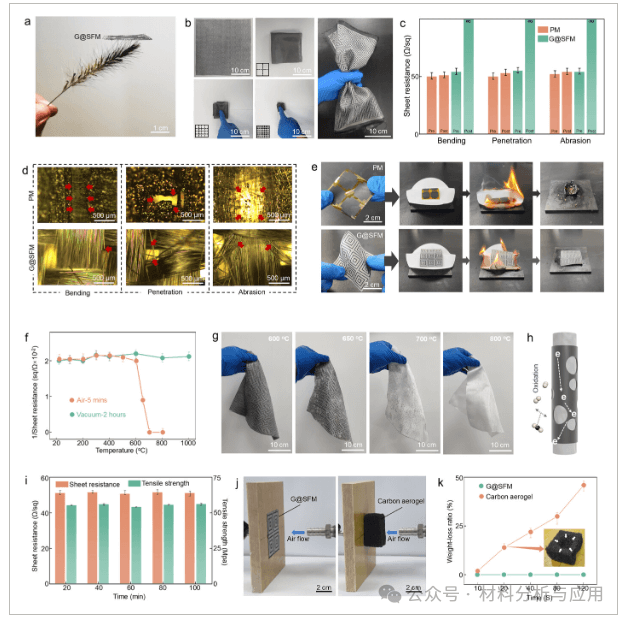
图4、Performance of G@SFM under harsh conditions. a) Lightweight property of G@SFM (3 cm × 3 cm). b) Digital photographs showing a large-scale G@SFM folded 6 times (clockwise). Inset: schematic of the corresponding folding mode. c) Sheet resistance of PM and G@SFM after physical tests (“Pre” represents the pristine sample, while “post” indicates the sample that has undergone one of the durability tests). Error bars represent the standard deviation from three devices (n = 3). d) Durability test results for PM and G@SFM (from left to right: bending, penetration, and abrasion). e) PM and G@SFM burning experiments. f) Sheet resistance of G@SFM after thermal treatment at different temperatures under vacuum and ambient air conditions. g) Morphologies of G@SFM after 5 min thermal treatment at temperatures from 600 to 800 °C in ambient air. Error bars represent the standard deviation from three devices (n = 3). h) Schematic of the high-temperature oxidation of the surface graphene. i) Sheet resistance and tensile strength of G@SFM after treatment at 500 °C in ambient air for 100 min. Error bars represent the standard deviation from three devices (n = 3). j) Airflow scouring tests of the carbon aerogel and G@SFM. k) Weight loss of the carbon aerogel and G@SFM after the airflow scouring test. Error bars represent the standard deviation from three devices (n = 3).
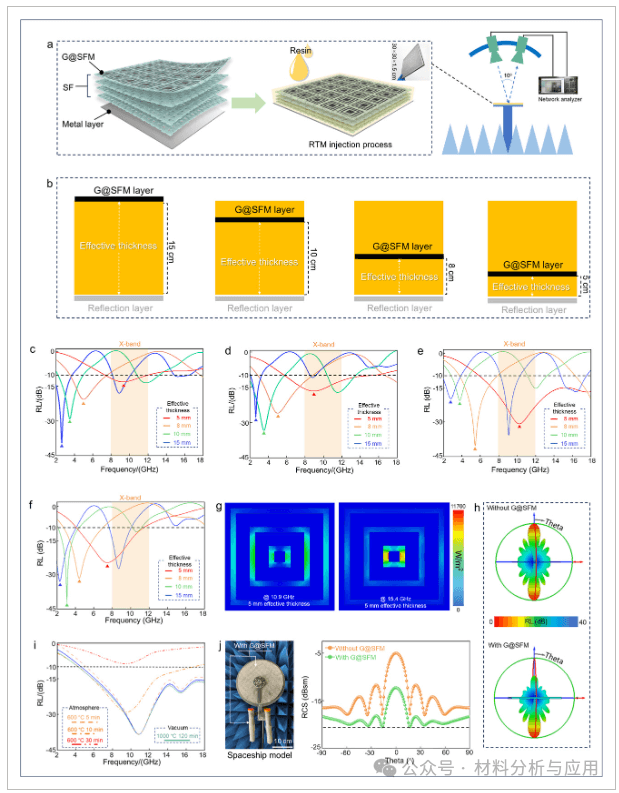
图5、Electromagnetic performance of the G@SFM absorbers. a) Schematic of G@SFM absorber fabrication. Inset: digital photograph of the as-fabricated G@SFM absorber. b) Position of G@SFM at various effective thicknesses. c–f) Dependence of RL characteristics on the dielectric layer thicknesses for G@SFM absorbers with sheet resistances of 200 Ω sq−1 (c), 150 Ω sq−1 (d), 100 Ω sq−1 (e), and 50 Ω sq−1 (f). g) Simulated power loss density of the metasurface unit cell (TL-pattern) at different frequencies. h) Simulated radiation pattern of the absorber with/without G@SFM. i) EMW absorption performance of G@SFM absorbers under different thermal treatment conditions. j) Spaceship model and corresponding radar cross section (RCS) curves with/without G@SFM.
小结
在本研究中,我们成功利用激光“擦除”技术开发出石墨烯@硅纤维膜(G@SFM),该技术利用了石墨烯与硅纤维对激光吸收率的差异。所得G@SFM展现出卓越特性:超薄厚度(约0.1毫米)、低面密度((106 g m−2))、优异柔性及可调片电阻(50-5000 Ω sq−1)。这些特性表明G@SFM是高性能电磁波吸收应用的理想候选材料。该材料还展现出优异的热稳定性,经严苛热处理后仍保持图案完整性和片电阻稳定,这对高速飞行器应用至关重要。此外,G@SFM具备卓越的机械耐久性及抗气流冲刷能力。为优化电磁波吸收效果,将G@SFM集成于飞行器隔热层,形成具备高温电磁波吸收能力的超表面吸收体结构。该G@SFM吸收体在约5GHz频率下实现最小反射损耗(RLmin)达−42 dB,显著降低航天器模型雷达截面积(RCS)。经空气中600℃持续5分钟及真空环境1000℃长期热暴露测试,其电磁波吸收性能保持稳定,满足航空航天与高速系统的严苛要求。
研究成果表明,G@SFM作为新一代电磁波吸收技术的变革性解决方案具有广阔前景,不仅能为航空航天应用提供结构与热稳定性,更可在卫星有效载荷防护、国防平台隐形表面、极端工业/空间环境下高温电子设备的电磁屏蔽等新兴领域展现扩展适应性。
未来研究可探索将G@SFM与相变材料或电压控制层等主动调谐元件集成,实现电磁响应的动态调控,从而在多变工况下实现实时适应性。所提出的激光图案化策略构建了多功能平台,可扩展至更高频段(包括毫米波与太赫兹频段),从而拓展其在下一代无线通信、空间传感及自适应隐身系统中的应用前景。
文献:https://doi.org/10.1002/adma.202516254
本文来自材料分析与应用,本文观点不代表石墨烯网立场,转载请联系原作者。