成果简介
作为低碳能源循环中极具前景的氢载体,氨同时也是大气中最丰富的碱性气体,通过多种地球物理和化学过程影响环境质量。因此,开发能在自供电模式下保持高灵敏度和稳定性的NH3传感材料至关重要。本文,清华大学周小红 长聘副教授团队在《ADVANCED SCIENCE》期刊发表名为“Ammonia Gas Sensor Fabricated by Multifunctional ZnO/GO Nanocomposites for Long-Term, Self-Powered Monitoring”的论文,研究展示了一种一步原位聚合法,用于合成氧化锌/氧化石墨烯(ZnO/GO)纳米复合材料,该材料既可作为氨气传感的气敏薄膜,又能作为超级电容器的高性能电极材料。
在超级电容器应用中,其比电容达到131 F g−1(电流密度1A g−1)。该氨气传感器具有低检测限(0.1 ppm)和快速响应/恢复时间(10 ppm NH3条件下17秒响应/26秒恢复),不仅超越美国职业安全与健康管理局设定的标准(50 ppm),更优于商用NH3气体传感器。通过将传感器集成至定点监测检测仪器,在连续210天测试中实现了低于1%的响应相对标准偏差。此外,研发的可穿戴式接触分离式热电纳米发电机(TENG),通过模拟人体步行的接触分离装置收集机械能,实现最大4.1毫瓦输出功率,可直接驱动氨气传感器。多场景应用显著提升了氨浓度监测的空间覆盖范围与操作灵活性。
图文导读
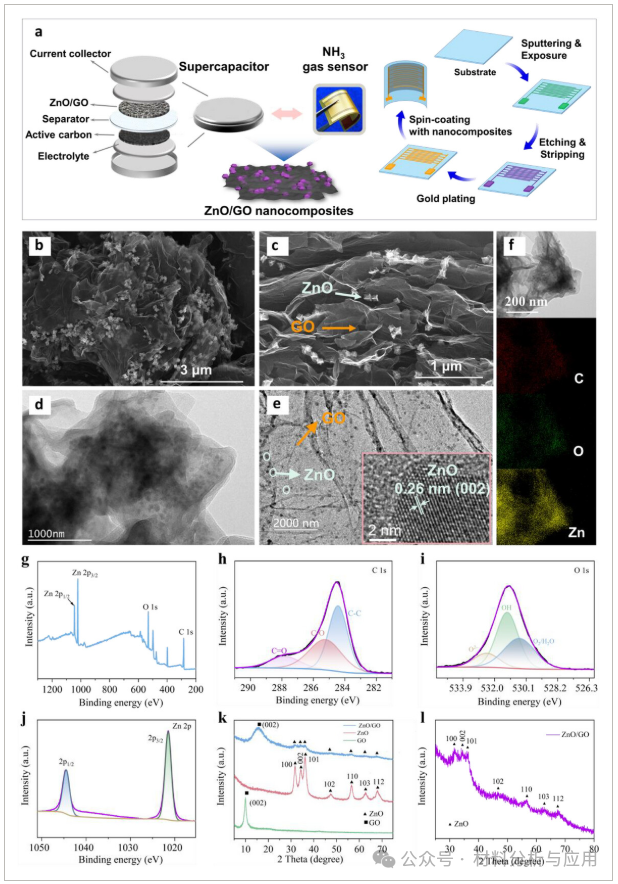

图1、Characterization of ZnO/GO nanocomposites. a) Schematic diagram of the preparation of ZnO/GO nanocomposites simultaneously used for the fabrication of supercapacitors and gas sensors. b, c) SEM and d, e) TEM image of the synthesized ZnO/GO nanocomposite. f) EDX elemental mapping of ZnO/GO nanocomposites. XPS spectra of ZnO/GO nanocomposites: g) Survey scan, h) C 1s, i) O 1s, j) Zn 2p, k) XRD patterns of ZnO, GO, and ZnO/GO nanocomposites. l) Amplified XRD patterns of ZnO/GO nanocomposites.
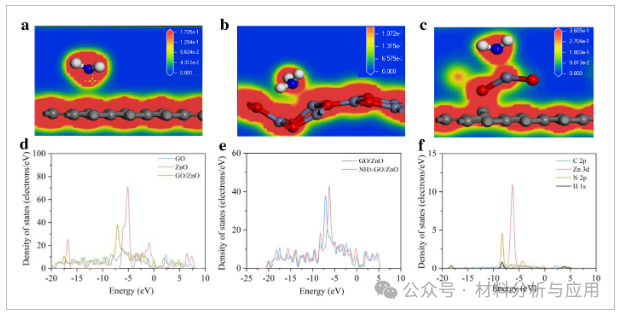
图2、Density functional theory (DFT) simulation of ZnO/GO nanocomposites. Charge density of a) GO, b) ZnO, and c) ZnO/GO after NH3 molecule adsorption (black: C atoms, blue: N, red: O, grey: Zn, white: H). d, e) TDOS diagrams of the ZnO/GO system before and after adsorption of NH3 molecules. f) PDOS diagrams of ZnO/GO system adsorption of NH3 molecules.
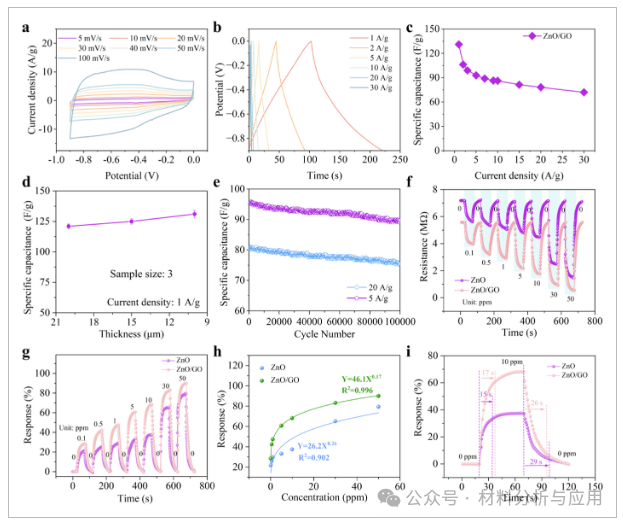
图3、Evaluation of supercapacitor and gas-sensing performance. a, b) CV and GCD curves of the ZnO/GO electrode. c) Specific capacitance of ZnO/GO electrode at different current densities. d) Specific capacitance of ZnO/GO-based supercapacitors fabricated with different thicknesses of electrode materials at a current density of 1 A g−1. e) Evaluation of the durability of the specific capacitance of the supercapacitor. f) The resistance changes of NH3 gas sensors based on pure ZnO and ZnO/GO composite under different NH3 concentrations at 20 °C. g) The response of NH3 gas sensors based on pure ZnO and ZnO/GO composite under different NH3 concentrations at 20 °C and h) Response fitting curves. i) The response/recovery characteristic curves at NH3 concentration of 10 ppm at 20 °C.
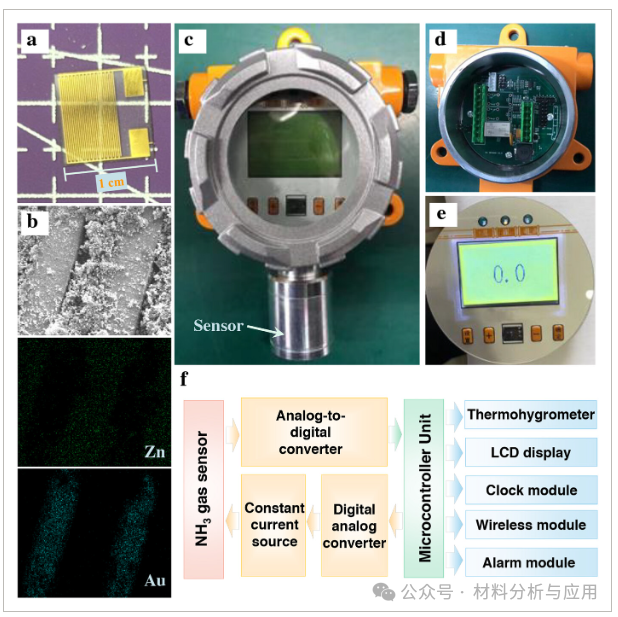
图4、Design and implementation of a ZnO/GO-based ammonia detection instrument. a) Photograph of the interdigital electrode for deposition of ZnO/GO nanocomposites. b) SEM images and elemental mapping of the ZnO/GO nanocomposites-deposited sensor prepared with the optimized spin-coating time of 60 s. Photographs of the integrated ammonia gas detector and its functional modules: c) external view, d) internal PCB module, and e) display screen. f) Schematic illustration of the system architecture of the ammonia gas detector.
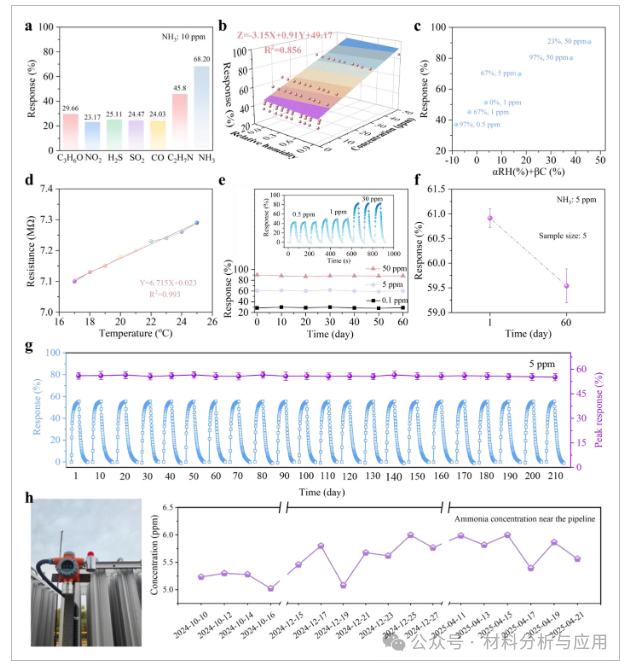
图5、Environmental endurance and stability tests of the ammonia gas detector. a) Selectivity of the ZnO/GO composite-based sensor. b) 3D scatter of the response vs both humidity and NH3 concentration for the ZnO/GO-based sensor. c) Linear behavior of the response vs both humidity and NH3 concentration for the ZnO/GO-based sensor. d) The temperature effect on the ZnO/GO-based sensor. e) Comparison of response/recovery time between this work and other types of NH3 gas sensors. f) Repeatability and stability measurement results of the ZnO/GO-based sensor under different NH3 concentrations. g) Long-term stability of ZnO/GO-based sensors over 210 days under exposure to 5 ppm NH3. h) Photograph of the installed ammonia detector and six months of NH3 concentration monitoring from October 10, 2024, to April 21, 2025.
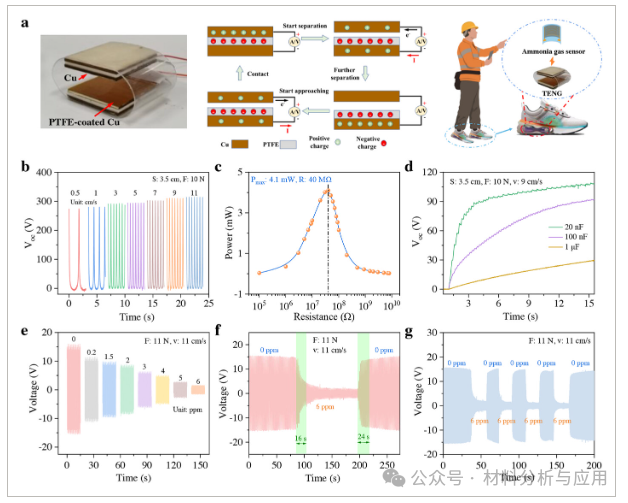
图6、Self-powered ammonia gas sensing by a wearable contact-separated TENG (WCS-TENG). a) The schematic diagram illustrating the structure, working principle, and application prospect of the WCS-TENG. b) Effect of speed on open-circuit voltage of WCS-TENG. c) Variation curve of WCS-TENG output power at different resistances. d) Capacitor charging curve of WCS-TENG. e) The voltage response of the sensor at varying concentrations of NH3 gas. f) Voltage fluctuations of the sensor during NH3 concentration transitions between 0 and 50 ppm. g) Response and recovery time of the sensor under the WCS-TENG-driven operation.
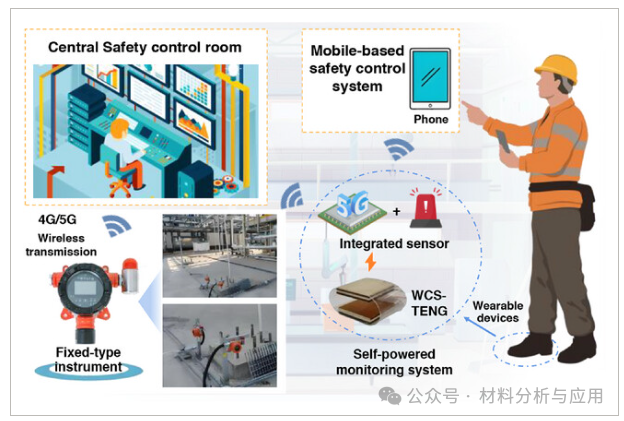
图7、Schematic diagram of application scenarios for fixed-type and self-powered ammonia monitoring systems.
小结
本研究通过原位聚合法成功制备了ZnO/GO纳米复合材料,其具有独特的结构特征:ZnO纳米颗粒均匀分布于GO片层之上。该结构赋予材料双重功能:作为超级电容器电极时,其在1 A·g⁻¹电流密度下展现出131 F·g⁻¹的高比电容,并具有卓越的循环稳定性(100,000次循环后容量保持率达94%); 作为氨气传感器,其在0.1-50 ppm范围内展现高灵敏度,响应/恢复时间达17/26秒(10 ppm浓度),并对干扰气体具有优异选择性。长期定点监测表明其稳定性卓越,210天内响应相对标准偏差低于1%,符合实际环境条件。此外,通过集成可穿戴式接触分离型热电纳米器件(TENG),基于ZnO/GO的氨气传感器实现了自供电运行,可在动态环境中持续检测NH3而无需外部能量输入。多场景应用显著提升了NH3浓度监测的空间覆盖率与操作灵活性,为智能可持续环境传感技术开辟了前景广阔的发展路径。
文献:https://doi.org/10.1002/advs.202516833
本文来自材料分析与应用,本文观点不代表石墨烯网立场,转载请联系原作者。